Séfora Camazano · Art About Identity
Art About
Identity
Contemporary portraiture exploring personal identity, cultural memory, migration, belonging and transformation.
“Identity is not a fixed image. It is something we build, inherit, question and transform throughout our lives.”
Identity in contemporary art
Art about identity as
a space for recognition
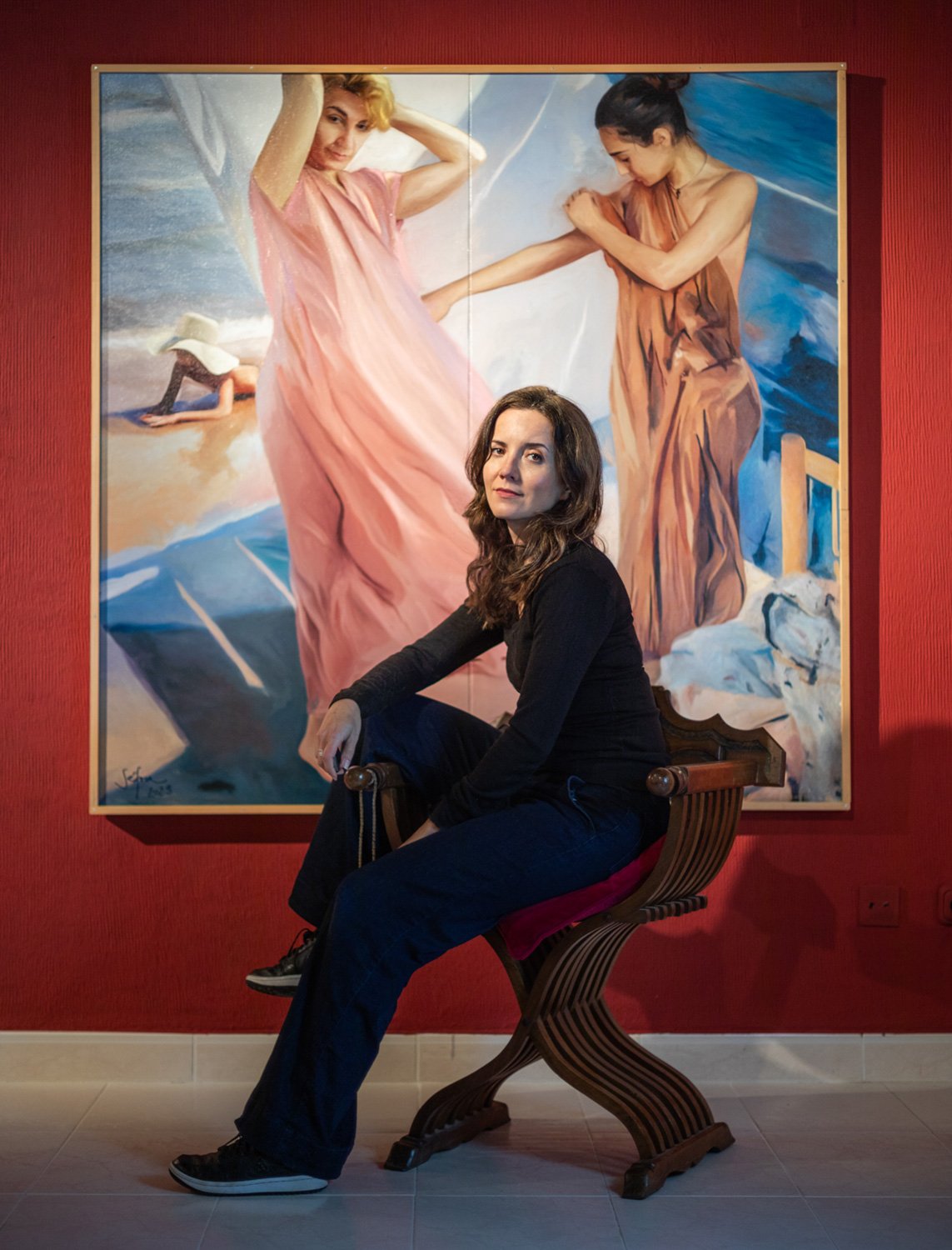
Séfora Camazano creates contemporary art about identity, memory and human experience. Her work examines how identity is shaped by origin, family, language, migration, social context and personal transformation.
Through portraiture, photography, digital painting and mixed-media intervention, Camazano explores the distance between how a person is seen and how that person understands herself.
The portrait becomes a place where visible appearance and invisible experience can coexist. It preserves the face while also making room for biography, memory, contradiction and change.
Personal and cultural identity
The self as something
inherited and transformed
Identity is never formed in isolation. It is influenced by family history, cultural traditions, social expectations, language, geography and the experience of belonging—or not belonging—to a place.
Camazano’s subjects often live between different cultural references. Their identities cannot be reduced to nationality, gender, profession or personal history alone.
Her work presents identity as layered and dynamic: something that contains the past while continuing to change in the present.
In this sense, the image does not define the person. It reveals the complexity of a self that remains open, evolving and resistant to simplification.
“To represent a person is not to explain who she is. It is to create enough space for her complexity to remain visible.”
— Séfora CamazanoPortraiture and self-representation
Who is allowed to define
the image of a person?
Portraiture has historically been used to preserve status, power and social identity. Camazano reconsiders this tradition by focusing on women whose lives and experiences are often absent from institutional representation.
The women in her work are not treated as passive subjects. Their stories, gestures, choices and presence influence the construction of the image.
This collaborative dimension is essential. The portrait is created through encounter rather than imposed from outside.
The result is not an illustration of identity, but a negotiation between how a person remembers herself, how she is perceived and how she wishes to be seen.

Female Portraits: Migrants · Museum of History of Valencia, 2023
Artistic methodology
Constructing identity through
story, image and presence
01
Listening
Conversation reveals the memories, experiences and cultural references that shape the person behind the portrait.
02
Interpretation
Photography and digital painting transform biography, gesture and atmosphere into a visual language.
03
Presence
Fine Art printing and material intervention give the represented person a lasting physical and symbolic place.
Central themes
Identity understood through
memory, culture and representation
Personal identity
Each portrait begins with the individual and preserves the complexity of a life that cannot be reduced to a single definition.
Cultural identity
Language, origin, traditions and migration shape how people understand themselves and their relationship with others.
Memory
Personal and family memories connect present identity with places, people and experiences that may no longer be physically present.
Representation
The work questions who creates images of others, whose identities are preserved and which stories enter collective memory.
Explore Séfora Camazano’s work
Discover contemporary art about
identity, memory and transformation.
Projects and artworks for collectors, galleries, museums and cultural institutions