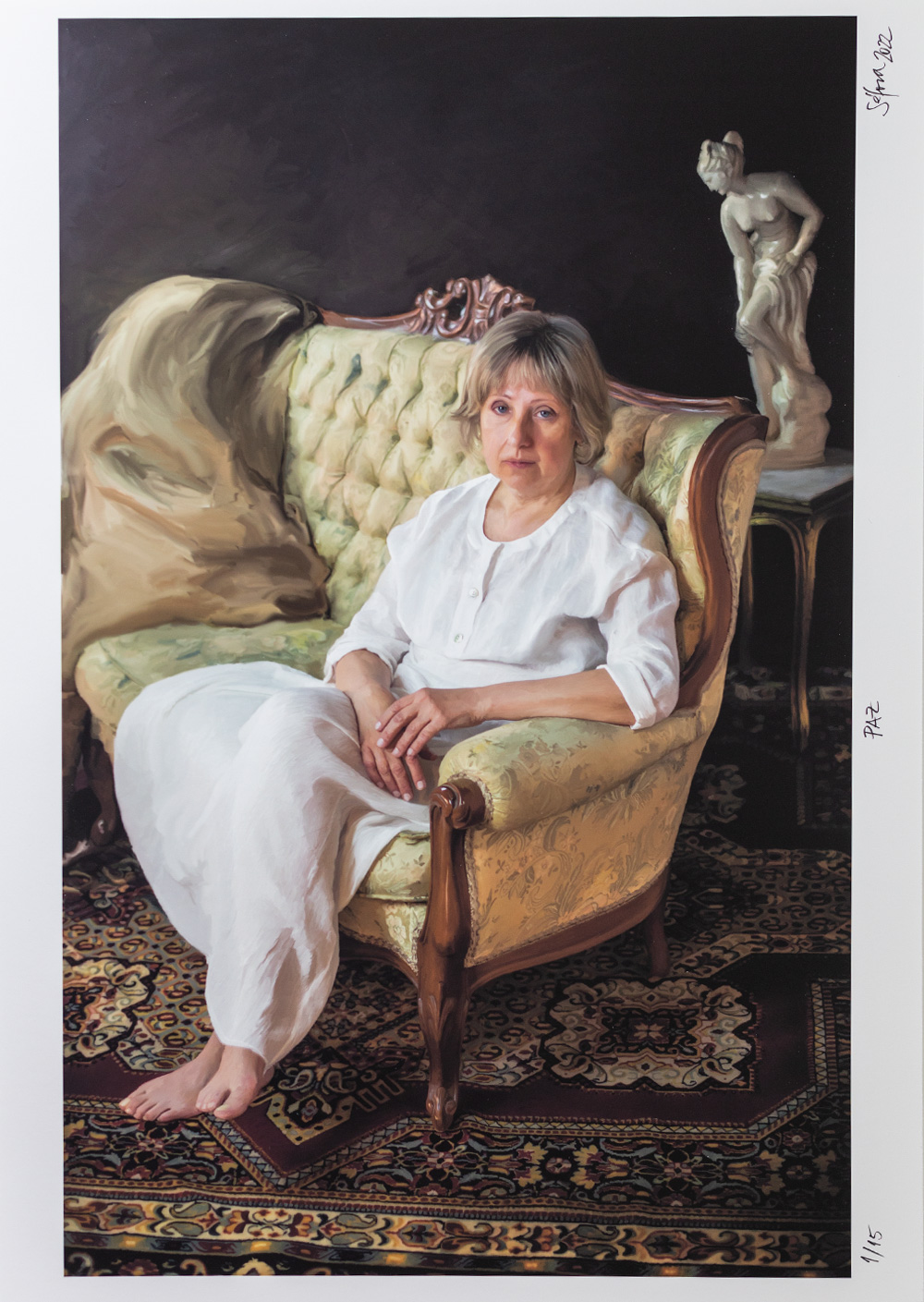
01 · The gaze
A direct presence
Tetiana looks directly at the viewer. She neither turns away nor adopts a conciliatory expression: her face holds the composition and establishes an immediate relationship with whoever stands before the work.
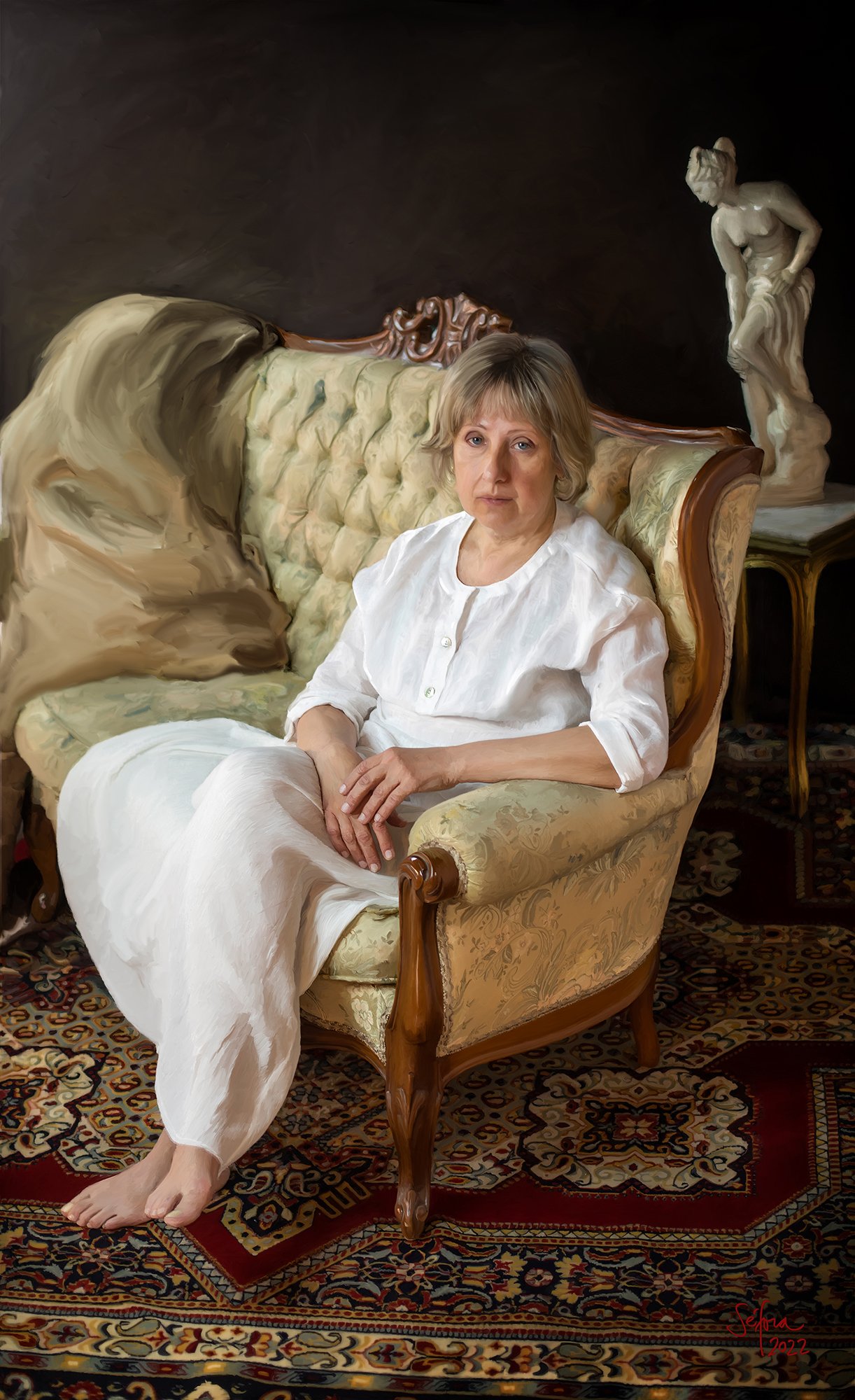
Female Portraits: Looking Back to the Past
Female Portraits: Looking Back to the Past
2022
Medium
Mixed media on 100% cotton, acid-free Fine Art canvas.
Dimensions
150 × 90 cm (59.05 × 35.43 in)
Year
2022
Series
Female Portraits: Looking Back to the Past
The protagonist
Tetiana is a Fine Arts teacher who arrived in Spain from Ukraine after war abruptly disrupted the life she had built in her country.
Displacement meant leaving behind people, places and relationships that had shaped her everyday life, and beginning again in unfamiliar surroundings while uncertainty remained on the other side of the distance.
“Peace” begins with something elemental: the desire to live without fear.
When Séfora Camazano portrayed her in 2022, Tetiana’s story already formed part of the experience shared by thousands of people forced to leave their homes by war. Yet the artwork refuses to reduce her to an image of conflict: before us remains, first and foremost, Tetiana.
Tetiana tells her story · Valencia, 2022
The meaning of the title
Peace emerged at a moment when the word had ceased to be an abstraction for Tetiana. After leaving Ukraine, it meant something tangible: safety, stability and the possibility of living again without war determining every decision.
The title does not refer only to the absence of conflict. It also speaks of everything war interrupts: everyday life, human bonds, a sense of belonging and the ability to imagine the next day.
By portraying Tetiana away from the theatre of war, the artwork shifts attention from the historical event to the individual who continues to exist beyond it.
“Peace begins where a person can once again imagine a life of their own.”
Keys to reading the artwork
01 · The gaze
Tetiana looks directly at the viewer. She neither turns away nor adopts a conciliatory expression: her face holds the composition and establishes an immediate relationship with whoever stands before the work.
02 · The white dress
White extends across almost the entire figure, contrasting with the deeper tones of the interior. Tetiana becomes the brightest point in the composition and the visual centre of the portrait.
03 · The bare feet
The bare feet introduce an intimate, everyday dimension. Set against the elegance of the sofa and the richness of the interior, this detail brings the portrait back to a human presence that feels immediate and unconstructed.
04 · The sofa
The large sofa almost entirely envelops Tetiana’s figure. Its curves, upholstery and carved wood create a visual architecture around her, reinforcing the intimate character of the portrait.
05 · The sculpture
To one side stands a classical female figure, elevated on a pedestal. Opposite her, Tetiana occupies the space as a real contemporary woman, with her own face, identity and history.
06 · The carpet
The carpet fills the floor with an intricate field of forms and colour. Its ornamental richness contrasts with the simplicity of the white dress, making Tetiana stand out even more strongly within an interior charged with visual memory.
Curatorial reading
Peace begins with a life shaped by war, yet deliberately resists making war its principal image. There is no destruction, displacement or explicit reference to conflict. Instead, the viewer encounters a singular figure held within a space of silence.
That shift is essential to the work. Tetiana may have entered the portrait as a consequence of a historical event, but the image returns attention to what such an event can never fully contain: her identity.
The visual tension is built precisely through absence. The viewer knows a story that the image does not literally depict and must confront the distance between what is known about Tetiana and what is actually seen.
Peace therefore occupies a space between portraiture and testimony without conflating the two. Biography gives the artwork depth; the sitter retains the right not to be reduced to it.
Artistic reference
Peace takes as its point of departure Clotilde Seated on a Sofa (1910), by Joaquín Sorolla. The position of the figure, the contrast between the light dress and dark interior, and the psychological concentration of the portrait remain recognisable within the new composition.
Séfora Camazano, however, replaces Clotilde with Tetiana and introduces a biography belonging to another time. The structure of an intimate early twentieth-century portrait now holds the presence of a woman whose life has been altered by one of the defining European conflicts of the twenty-first century.
The dialogue is not an attempt to reproduce Sorolla, but to retain the memory of his composition and subject it to a new question: what happens to a familiar image when the woman occupying that place no longer belongs to art history, but to our own contemporary moment?

Clotilde Seated on a Sofa
Joaquín Sorolla · 1910
Creative process
The process behind Peace began with Tetiana and with listening to her story. Sorolla’s painting then provided a compositional framework from which to construct a contemporary portrait without literally illustrating what she had lived through.
During the photographic session, the position of the figure, the relationship between body and space and several essential elements of the composition were reconstructed. Tetiana does not perform the role of Clotilde; she occupies that structure through her own body, expression and presence.
The photograph is subsequently transformed through digital composition and painting, and the process culminates in hand-painted intervention on the printed work. Photography and painting no longer operate as separate languages, but participate in the construction of a single contemporary image.


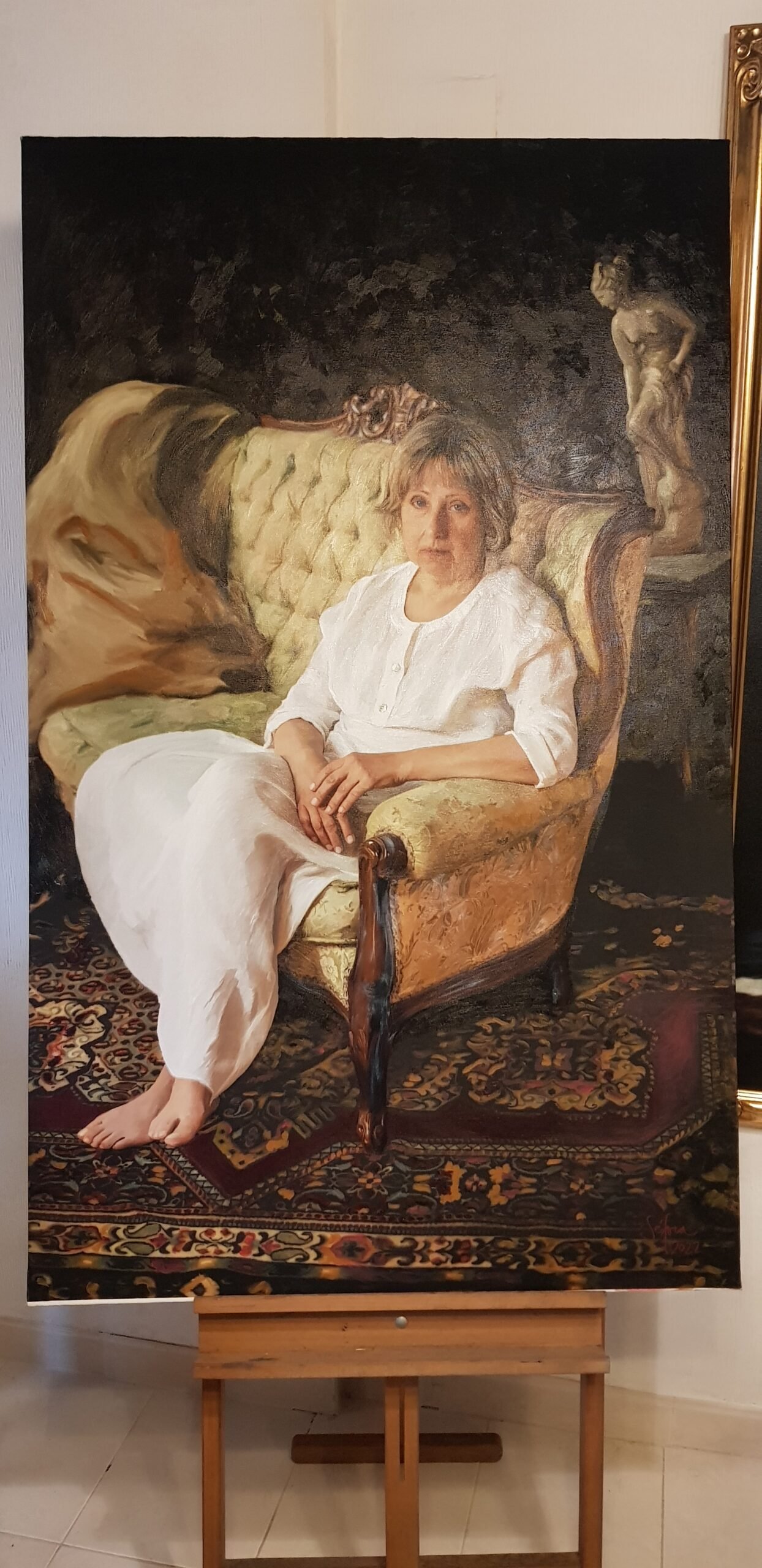
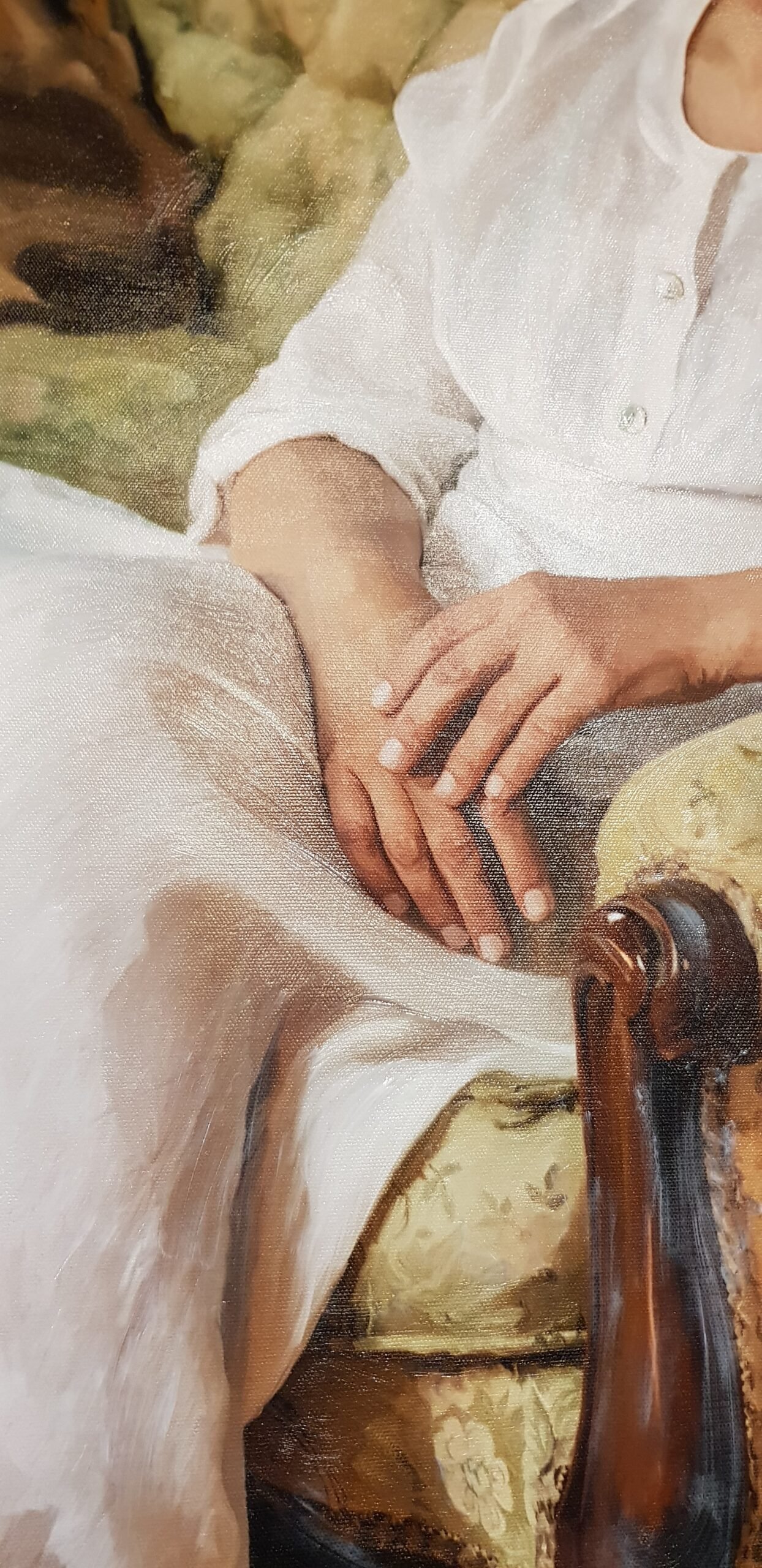
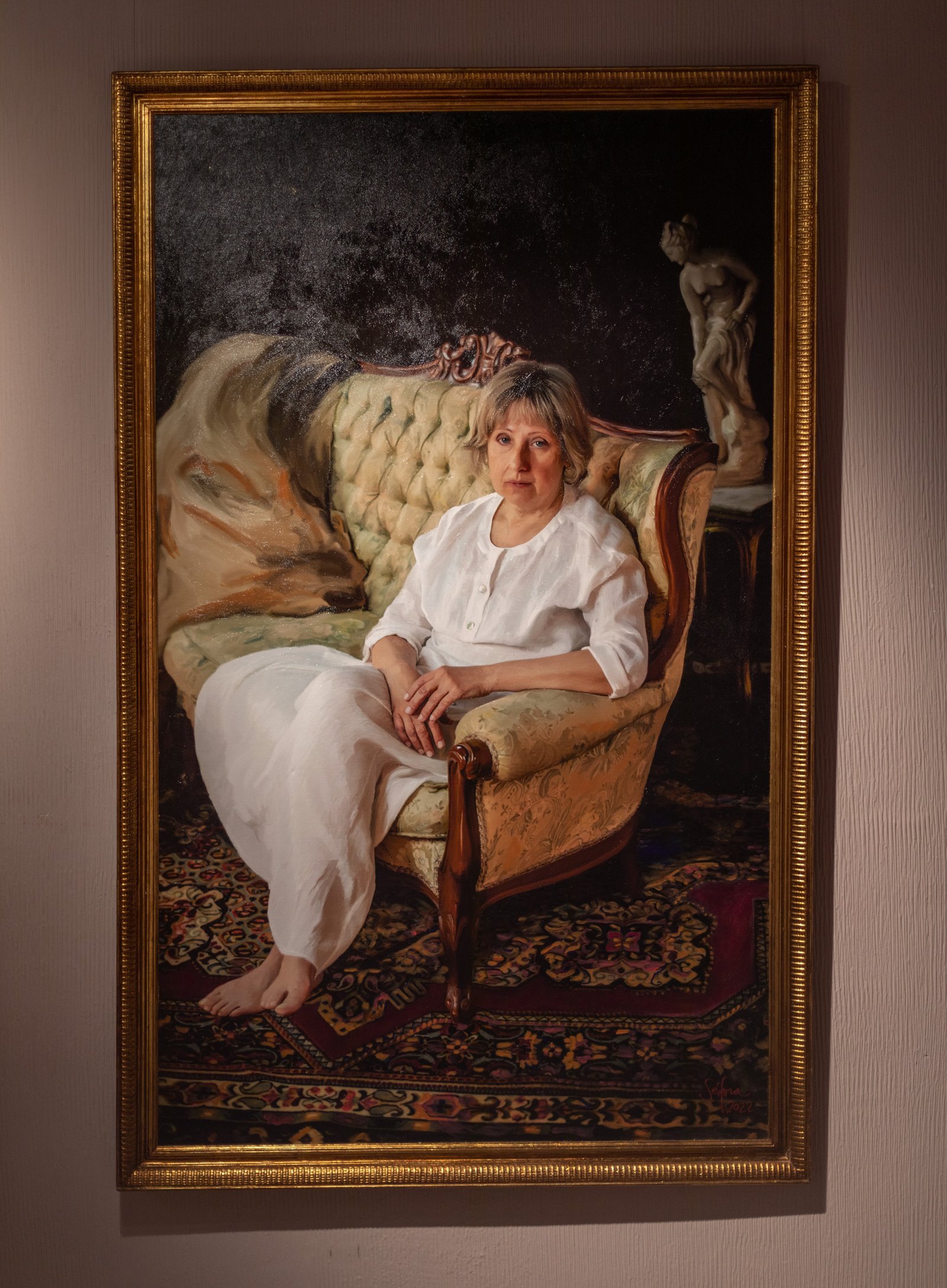
Peace in the artist’s studio · Valencia
Exhibition history

The Westin Valencia
Valencia, Spain · 2023
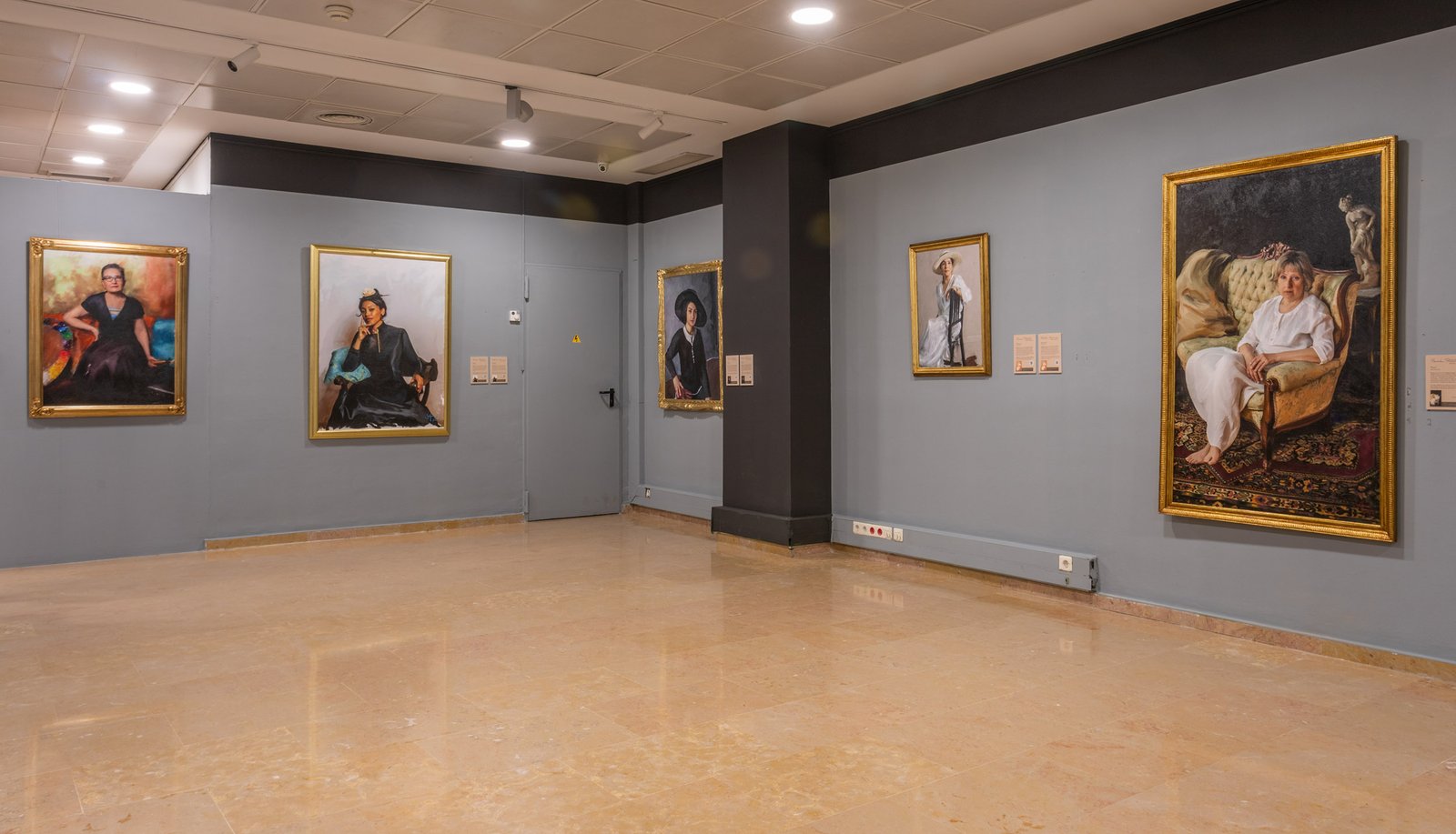
Botanical Garden of the University of Valencia
Valencia, Spain · 2024
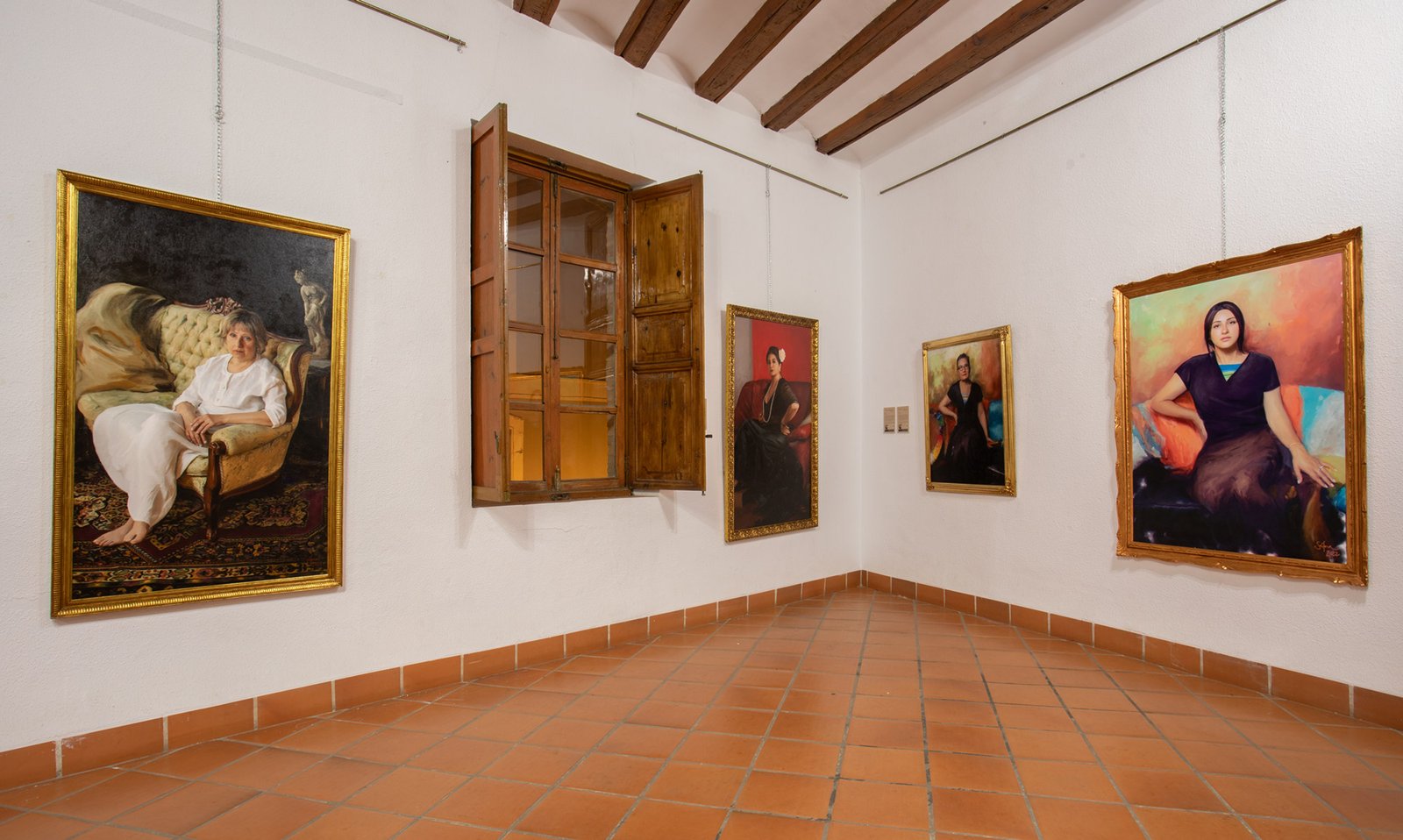
Former Bétera Town Hall
Bétera, Spain · 2024
Galerie Portraits
Interested in this artwork?
I personally respond within 48 hours
Enquire about the artworkThe original artwork includes